Sunday, October 30, 2011

Secound Paragraph Blog 23


Both the ghost and Claudius seem to initially share the same pattern of speech; however, at closer inspection, the ghost speaks time were of the essence while Claudius speaks as if he has all the time in the world. There are many cases in which the ghost contrasts directly with the Claudius in both the message’s each try to convey and the speech patterns of each character. Claudius’s first lines in the play are to announce his brothers death and his new marriage: “Have we as ‘twere with the defeated joy, with an auspicious and a dropping eye, with mirth in funeral and with dirge in marriage, in equal scale weighing delight and dole taken to wife” (1.2. 10-15). Only two weeks after Hamlet Sr.’s death, Claudius has married Hamlet Sr.’s widow and has become king by taking the power away from Hamlet.  Claudius seems to blend two speeches into one, the happy speech about his marriage and the sad speech about his brother’s death into one speech that mixes the sadness of the death with the happiness of the wedding. Furthermore, the intension of Claudius’s speech is to announce his marriage; however, it takes Claudius close to ten lines before he finally claims his point and when he finally announces his marriage, his words come out completely perverted due to his juggling of the two speech’s in his head. Unlike Claudius, the ghost speaks with many words but gets his point across much quicker than Claudius: “Ay, that incestuous, that adulterate beast,
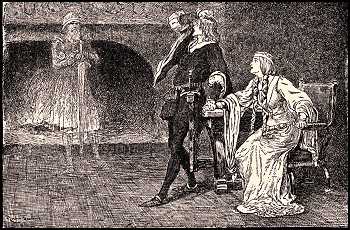
with witchcraft of his wit, with traitorous gifts, -- o wicked wit and gifts, that have the power So to seduce!” (1.5.40-44). Unlike Claudius the ghost instantly makes his point through the use of strong imagery and language to attack his brother for murdering him and then marrying his widow. Furthermore, it is made obvious that Claudius has done something very wrong because the ghost uses such strong language in order to describe Claudius’s actions it is not a far leap to make to assume that the ghost will ask Hamlet to avenge his most unnatural murder.

Wednesday, October 26, 2011

Pg. 742 Figurative Language Blog 22


Pg. 742, line 41 to the end of the page.

Shakespeare’s use of figurative language helps to set the tone for the perspective scene. The language helps the reader get an image in their head and helps to relieve some tension from a heavy seen. When the ghost says, “O Hamlet, what a falling-off was there! From me, whose love was of that dignity that it went hand in hand even with the vow I made to her in marriage, and to decline upon a wretch whose natural gifts were poor to those of mine” while the ghost is very long winded, his metaphor for his love for his wife gives a very intimate account of how his love was out of duty when it should have been for love. Further more, the ghost’s figurative speech help to make a simple point that he loved her for duty and she should not have married while his body was still warm into a more descriptive and entertaining speech and also matches Shakespeare in making his plays iambic pentameter.

Tuesday, October 25, 2011

Setting Blog 21


The setting of a story changes between a play and a novel. In novels like Pride and Prejudice, the setting helps to set the tone of the novel which include things like the tonal patterns of the characters and their financial circumstances and things that the audience cannot experience because they are not in the room with the characters. On the other hand, plays set the same guidelines with setting but they also outline how a room or location has to look. In Hamlet, the setting of each room is left up to the director because Shakespeare does not right in specific details about the room but still portray the room’s interior setting more thoroughly hen a novel might describe them. In Hamlet, the setting is also important to explain the overall mood of Denmark because it explains that the story takes place after the king’s death and with a new, illegitimate king upon the throne.

Sunday, October 23, 2011

Hamlet Opening Paragraph Blog 20


Just like people, the characters in Shakespeare’s Hamlet have very different speech patterns. Hamlets real father, the ghost, and hamlets adoptive father, Claudius, are complete foils of one another. Where the ghost specks directly and makes his point obvious, Claudius hides his messages in long winded sentences that sound pleasant to anyone who doesn’t get the true meaning behind them. Besides creating more depth for his characters, Shakespeare’s decision to give each character there own speech patterns allow any actor who tries to perform the role and easier way of “getting in the mind of the character” because each character is very different from one another. While Hamlet involves many different characters all with different patterns of speech, Hamlets two fathers show the contrast between the different reins in the kingdom, one that had happiness and truth to a dark and kin slaying society that Claudius has created.

Wednesday, October 19, 2011

Make Love not Wordcraft: Hamlets Two Fathers Blog 19


If I had to compare and contrast two characters speech patterns in hamlet, I would chose to write about the ghost (hamlets father) and Claudius Hamlets step father/ uncle. They each have there own specific ways of speaking, while Claudius shares a speech pattern with Hamlet, Claudius and the ghost are opposites. The ghost speaks in long sentences but is extremely forthcoming with his information “the serpent that did sting they fathers life now wears his crown” (742). The ghost out right tells hamlet who killed him and then tells hamlet how he should only seek revenge on his uncle and not his incestuous mother. One the other hand, Claudius is extremely lucrative in his speech, trying to almost never give away any information. Even when he commands hamlet that he cannot go back to Germany to attend school, he does not out right say “no” but instead he beats around the bush and when he does say that hamlet cannot go, he makes it sound like advice that hamlet should not go when really it is a royal decree.

Tuesday, October 18, 2011

Character Blog 18


Character is a term used to describe the players active in any form of art.  A character can range from an animal to a person and everything in between. In beauty and the beast, the candle is even a character.

In Hamlet, characters are introduced when they are given lines; for example, Benardo, the first main character introduced, simply is called his name and then he says his lines. Character development in hamlet follows the same pattern where there is no description of a character and the only information you gather about them you have to gather from what people say about that character or how that character speaks to others. In Pride and Prejudice however, characters are introduced with many physical or emotional qualities because there is a narrator to explain their character outright. The narrator, who is also a character, allows the reader to get into the minds of the other characters in the novel where as in many of Shakespeare plays, there are no narrators in the same sense and so everything the audience knows about characters in Shakespeare plays come from how others speak about them and how they speaks about others.

Sunday, October 16, 2011

Claudius Vs. Hamlet Round One Blog 17


In Claudius’s speech to Hamlet, Claudius insults hamlet by implying he that Hamlet should not wear mourning cloths because the required time for mourning is finished; however, Hamlet responds by informing Claudius that in reality he is still mourning even though the required time is past. Claudius further insults hamlet by stating that Hamlet will inherit the kingdom after Claudius death even though by right the kingdom should already be hamlets. The last jab Claudius gives hamlet is that Claudius denies hamlets request to go back to school and claims he must stay in Denmark. Hamlet responds to his uncle by telling his uncle that his mourning is real and that he is still saddened and he can see that his uncle is simply trying to trick him.